Queer Places:
Tannery Hill, 635 Newark Granville Rd, Granville, OH 43023, USA
Oberlin College, 101 North Professor St, Carnegie Building, Oberlin, OH 44074
Wellesley College (Seven Sisters), 106 Central St, Wellesley, MA 02481
Maple Grove Cemetery, 350 E Maple St, Granville, OH 43023, United States
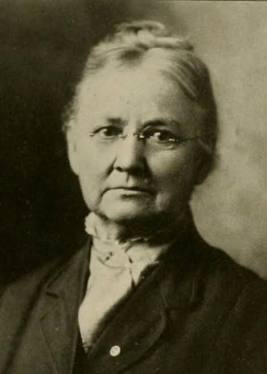 Ellen Amanda Hayes (September 23, 1851 – October 27, 1930) was an American mathematician, astronomer, educator, and radical political activist. Known for her outspoken
radical views, fierce intellect, and unconventional lifestyle, Hayes spent over three decades pushing boundaries both inside academia and in the public sphere.
Ellen Amanda Hayes (September 23, 1851 – October 27, 1930) was an American mathematician, astronomer, educator, and radical political activist. Known for her outspoken
radical views, fierce intellect, and unconventional lifestyle, Hayes spent over three decades pushing boundaries both inside academia and in the public sphere.
Born in Granby, Ohio, Hayes was educated at Oberlin College, earning her A.B. in 1878. After briefly teaching at Adrian College, she joined the faculty of Wellesley
College in 1879, where she remained until her retirement in 1916.
At Wellesley College, Hayes was a trailblazing presence in the STEM fields during an era when women were rarely admitted to higher scientific posts.
In 1888 she was appointed Chair of Mathematics. Assumed leadership of the Mathematics Department at Wellesley College, driving rigorous academic standards for female
scholars.
In 1897 she was granted the Chair of Applied Mathematics. Appointed as head of the newly established Applied Mathematics Department, expanding the curriculum into
analytical mechanics and astronomy.
In 1904 she published precise orbital calculations for asteroid 267 Tirza based on observations taken at the Leander McCormick Observatory
(University of Virginia).
In 1929, in her late seventies, established a school for young working women in Massachusetts, the Vineyard Haven School, continuing her commitment to radical
education until her death.
During the decade from 1900 to 1910, Hayes was an influential, albeit controversial, figure on campus:
Hayes focused heavily on applied mathematics and astronomy. In 1904, she calculated the orbit of the minor planet 267 Tirza, cementing her reputation as an
observational and mathematical astronomer.
Hayes did not restrict her intellect to mathematics. During this decade, she became actively involved in the suffragist movement, temperance, socialist politics, and
labor rights. She routinely drew scrutiny from conservative college trustees for her public endorsement of socialism and her active participation in labor union
causes.
Hayes rejected typical 19th- and early 20th-century gender norms in both dress and conduct. She was famous on campus for wearing practical, tailor-made clothing
rather than traditional restrictive Victorian garments, and she championed physical health and outdoor activity for women.
During her tenure at Wellesley, Hayes was part of a distinct social phenomenon termed the "Wellesley Marriage"—a specific form of "Boston marriage" common among
unmarried female professors at single-sex women's colleges during the late 19th and early 20th centuries.
"Wellesley Marriage" refers to long-term, cohabitating romantic and domestic partnerships between female academics. These arrangements provided personal intimacy,
shared domestic labor, and financial independence free from traditional patriarchal marriage structures.
In contemporary historical and queer studies, Ellen Hayes is recognized within the network of early 20th-century queer female academics. While the vocabulary of
modern LGBTQ+ identity (such as "lesbian") was not used in the modern sense during her lifetime, her life choice to remain unmarried, cohabit long-term with female
colleagues, and advocate for women's autonomy aligns with historical queer women's networks.
Wellesley College during the 1900–1910 era harbored a notable community of women living in domestic partnerships, including prominent figures like
Katharine Lee Bates (author of "America the Beautiful") and her partner
Katharine Coman, as well as Vida Dutton Scudder. Hayes was closely
integrated into these progressive, women-centered academic and social circles.
Hayes explicitly questioned traditional gender roles, family structures, and socio-economic expectations, advocating for complete financial and emotional independence
for women.
After retiring from Wellesley in 1916, Hayes devoted her remaining years entirely to radical politics and education:
In 1912, she joined the Socialist Party of America and became the party's candidate for Massachusetts Secretary of State—making her the first woman in state history
to run for a statewide office.
She was a vocal defender of Sacco and Vanzetti during their trial and execution in the 1920s, resulting in her arrest at age 76 for holding an illegal
demonstration.
She authored several books, including Wild Turkeys and Tallow Candles (1920) and a utopian novel, The Unwritten Constitution (1921).
Ellen Hayes passed away on October 27, 1930, in West Park, New York. Her bequest requested that her brain be donated to the Wilder Brain Collection at Cornell
University to contribute to scientific research on brain structure.
References:
Other references:
- Wellesley College Archives (Wellesley, MA): Faculty Files & Departmental Records
- Wellesley College Archives (Wellesley, MA): Wellesley College Presidents' Reports & Trustees Records
- Wellesley College Archives (Wellesley, MA): The Wellesley College News Archives
- Oberlin College Archives (Oberlin, OH)
- Leander McCormick Observatory Records (University of Virginia):
- Wilder Brain Collection Archives (Cornell University, Ithaca, NY)
- Hayes, Ellen. (1891). Lessons on Higher Algebra. Boston: Wellesley College.
- Hayes, Ellen. (1896). Elementary Trigonometry. Boston: J.S. Cushing & Co.
- Hayes, Ellen. (1897). Algebra for High Schools and Colleges. Boston: J.S. Cushing & Co.
- Hayes, Ellen. (1900). Calculus with Applications: An Introduction to the Mathematical Treatment of Science. Boston: Allyn and Bacon.
- Hayes, Ellen. (1904). "Orbit of Minor Planet 267 Tirza." The Astronomical Journal.
- Hayes, Ellen. (1909). Letters to a College Girl. Boston: Public Education Association.
- Hayes, Ellen. (1920). Wild Turkeys and Tallow Candles. Boston: Four Seas Company (A narrative history of pioneer life in Granville, Ohio).
- Hayes, Ellen. (1921). The Unwritten Constitution: A Path to True Americanism. Washington, D.C.: Natural Press (A utopian political commentary on American social democracy).
- Hayes, Ellen. (1929). The Sycamore Trail. (A historical novel published shortly before her death).
- Hayes, Ellen. (Editor/Publisher, 1920s). Relay. A self-published radical monthly journal focusing on labor, socialism, and social reform.
- Grinstein, Louise S., & Campbell, Paul J. (Eds.). (1987). Women of Mathematics: A Bio-Bibliographic Sourcebook. New York: Greenwood Press.
- Green, Judy, & LaDuke, Jeanne. (2009). Pioneering Women in American Mathematics: Pre-1940 PhDs. History of Mathematics, Vol. 34. Providence, RI: American Mathematical Society / London Mathematical Society.
- O'Connor, J. J., & Robertson, E. F. MacTutor History of Mathematics Archive. School of Mathematics and Statistics, University of St Andrews, Scotland.
Support this project
This website is a passion project researched, developed, and funded entirely by me. If you find the content valuable and would like to help support the ongoing research and hosting costs, any contribution is deeply appreciated.
Thank you for keeping this independent resource alive!
My books on Amazon: Elisa Rolle's books
BACK TO HOME PAGE